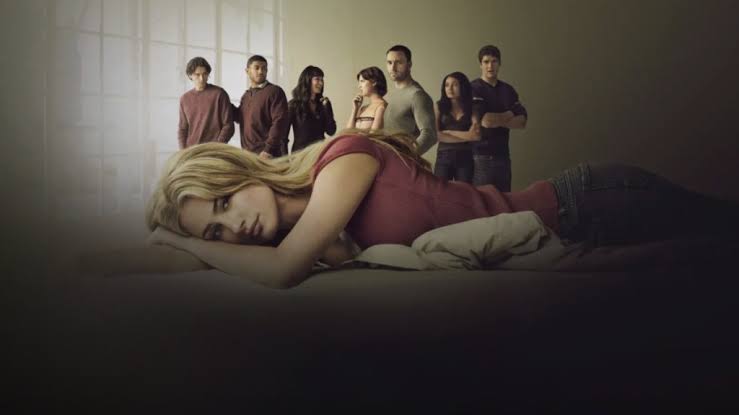
From the very first episode, 56 Days sets up an unsettling promise that begins as a chance meeting between two strangers and will eventually spiral into obsession, deception, and murder. The series, inspired by Catherine Ryan Howard’s novel, uses a clever non-linear narrative to keep viewers guessing until the final moments. What truly elevates the story, however, is its emotionally layered ending one that reframes everything we thought we understood about Oliver, Ciara, and the dark forces pulling their strings.
Here’s a complete, in-depth explanation of the ending of 56 Days, breaking down who died, why it happened, who Ciara really is, and what the final scenes truly mean.
A Romance Built on Secrets
The story begins innocently enough as Oliver and Ciara meet in a supermarket, a moment that feels almost cinematic in its simplicity. Their chemistry is instant, magnetic, and disarming; the spontaneous spark quickly evolves into an intense romance that unfolds during a limited window of time. Yet from the start, the show subtly suggests that something is wrong.
By intercutting scenes of their growing closeness with grim flashes of a decomposing body discovered in Oliver’s bathtub, the series creates an atmosphere thick with dread. The audience is constantly trapped between tenderness and terror, trying to piece together how this seemingly perfect romance could lead to such horror.
As the story unfolds, it becomes clear that both Oliver and Ciara are carrying deep, buried trauma; secrets that slowly come to the surface and reshape everything.
The Body in the Bathtub: Who Was Killed?
Throughout the season, the central mystery revolves around the identity of the corpse found in Oliver’s apartment. The police debate whether the victim is Oliver or Ciara, with evidence pointing in both directions; the ambiguity heightens the tension, keeping viewers in a constant state of uncertainty.
The truth, when it finally arrives, is far more shocking: the body belongs to Dan Troxler, the man believed to be Oliver’s therapist.
The revelation flips the entire narrative. Dan, who initially appears to be a stabilising presence in Oliver’s life, is exposed as the true villain, a master manipulator who has been quietly orchestrating devastation for years.
Why Was Dan Killed?
Dan’s death is not random, impulsive, or purely emotional. It is the culmination of years of exploitation, deceit, and psychological abuse.
Though he presented himself as a therapist, Dan was never qualified. Instead, he used his fake credentials to embed himself into the lives of vulnerable individuals, especially those with money and trauma. Oliver, coming from a wealthy family and burdened by a tragic past, was the perfect target.
Dan manipulated Oliver into dependency, subtly controlling his thoughts, decisions, and sense of guilt, but his crimes extended far beyond emotional exploitation. Years earlier, he had orchestrated a horrifying chain of events involving Oliver and his childhood friends; it was a sort of manipulation that ultimately resulted in death, imprisonment, and shattered families.
When Dan confronts Oliver in front of Ciara, he attempts to repeat his old tactics, trying to isolate Oliver once more and fracture his connection with Ciara. But this time, his manipulation backfires. Ciara sees through him and recognising that Dan represents an ongoing threat, she acts decisively, killing him to finally free Oliver from his psychological prison.
In that moment, the series reframes murder as a twisted form of liberation; morally complex, deeply unsettling, yet emotionally understandable within the context of the story.
The Long Game of Revenge
One of the most haunting revelations of the series is Ciara’s true identity; her involvement with Oliver is no coincidence. Their supermarket encounter, once believed to be fate, is revealed to be a carefully orchestrated plan.
Ciara is the younger sister of Shane - one of Oliver’s childhood friends whose life was destroyed in the wake of a tragic crime. Years ago, Oliver killed their mutual friend Paul, and Shane was wrongly sent to prison, where he eventually took his own life. The ripple effects devastated their family, driving their father to suicide and leaving Ciara and her mother in emotional ruin.
Initially, Ciara returns with the intent to seek revenge. She inserts herself into Oliver’s life, intending to dismantle him emotionally and make him suffer for what he did to her brother. But as she grows closer to him, she begins to see the full picture. Oliver was not a monster acting out of cruelty; he was a broken boy manipulated by Dan into making irreversible choices; her emotional conflict becomes one of the series’ most compelling elements, forcing her to reconcile justice with compassion.
The Police Plot and the Final Cover-Up
As the police investigation tightens around Oliver and Ciara, another character quietly steers the story toward its resolution - Karl Connolly.
Recognising the damage Dan inflicted not only on Oliver but on countless others, Karl orchestrates an elaborate cover-up. He plants evidence implicating Lee Reardon’s abusive partner and known drug dealer, ensuring that the blame for Dan’s murder falls on someone already entrenched in criminal activity.
The decision highlights one of the show’s core themes: justice in 56 Days is not clean or straightforward. The law, morality, and survival blur into uncomfortable gray areas. While Dan’s death is technically a crime, the series frames it as the destruction of a predator; it was a necessary evil to prevent further harm.
A New Beginning or a Fragile Illusion?
Initially, Oliver intends to confess; the weight of his guilt, not only for Dan’s death but for his past, threatens to crush him. Yet Ciara convinces him that surrender would only perpetuate Dan’s legacy of destruction.
Together, they choose escape; they disappear, building a new life far from their past identities. The final scenes reveal that they have a child and appear, at least outwardly, peaceful. Ciara, now more grounded and emotionally healed, urges her mother to move forward as well, offering financial support and closure.
Yet beneath this hopeful surface lies an uneasy tension; their happiness is built upon buried bodies, concealed crimes, and unresolved trauma. The series leaves us questioning whether true peace is possible when the past is merely hidden rather than confronted.
Thematic Meaning of the Ending
The ending of 56 Days is deeply layered, exploring themes of control, trauma, redemption, and moral ambiguity.
At its heart, the series examines how trauma bonds people together; not through health or stability, but through shared pain and survival instincts. Oliver and Ciara don’t fall in love despite their trauma; they fall in love because of it.
The relationship becomes a sanctuary and a battlefield, forcing them to confront their deepest wounds. By killing Dan, Ciara symbolically ends the cycle of manipulation that defined their lives, but the moral cost of that choice lingers.
Rather than offering a clean resolution, the show embraces emotional complexity. There are no pure heroes or villains, only broken people navigating unbearable circumstances.
How the Series Ending Differs from the Novel
Fans of the original novel may find the series’ ending surprising, even controversial. While the book leans toward a darker, more morally rigid conclusion, the adaptation opts for emotional resolution and romantic redemption.
This shift gives the series a more hopeful, yet morally ambiguous tone. It suggests that healing is possible but never simple; the change opens space for deeper conversations about justice, accountability, and emotional survival in a world shaped by trauma.
A Disturbing Yet Powerful Conclusion
56 Days succeeds not just because of its twists, but because of how deeply it invests in emotional storytelling. The ending doesn’t simply reveal who died; it redefines the entire journey.
By exposing Dan as the hidden villain, unveiling Ciara’s true purpose, and allowing Oliver and Ciara to choose life over punishment, the series crafts a conclusion that is haunting, provocative, and deeply human.
It’s a finale that lingers long after the screen fades to black, forcing viewers to wrestle with uncomfortable questions about guilt, forgiveness, and the price of freedom and perhaps that lingering discomfort is exactly what makes 56 Days so unforgettable.
Read more: 56 Days ending breakdown