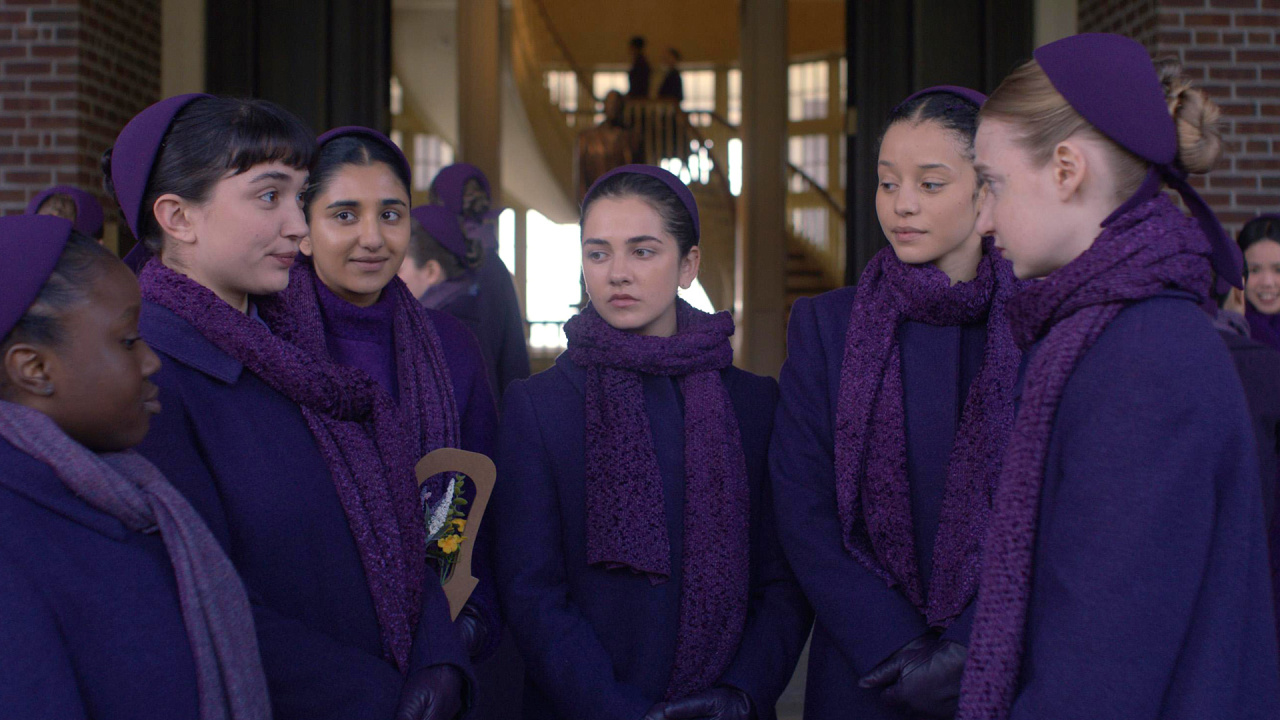
The first three episodes don’t feel like separate chapters—they feel like one long, uneasy breath. You’re dropped back into Gilead, but this time it’s quieter, more controlled… and somehow even more disturbing because of it.
We start with Agnes!
She’s older now, but there’s something childlike still clinging to her, not innocence exactly, more like conditioning. She moves through her house like she’s memorised every step she’s allowed to take, even the way she speaks feels rehearsed, like she’s been taught not just what to say, but what not to think.
Her home looks peaceful, but it doesn’t feel safe; her stepmother, Paula, keeps smiling in that tight, polite way that never reaches her eyes. Every compliment she gives Agnes comes with a sting tucked inside it; you can tell right away this isn’t love, it’s control dressed up as care.
At school, things don’t get any better. The girls sit straight, speak softly, and absorb everything they’re told like it’s gospel. They’re taught how to behave, how to walk, how to exist without ever drawing the wrong kind of attention, and the scariest part is that most of them don’t question it. Agnes doesn’t either!
Then Daisy shows up, and she’s like a glitch in the system; she doesn’t move like the others. She doesn’t speak like them there’s an edge to her, something unpolished and unpredictable. You can immediately feel that she doesn’t belong here, no matter how hard she tries to act as she does, and Gilead notices.
There’s this moment when the girls are forced to witness punishment; brutal, public, and meant to “teach.” Agnes stands there, steady, almost numb. Daisy can’t handle it, so she reacts, not loudly, but enough, enough to mark her. That’s when you start to see the difference between them clearly, as Agnes has learned to survive by accepting. Daisy survives by resisting, even when she shouldn’t.
By the end of the first episode, you realise Daisy is hiding something bigger than the radio she listens to; there's a connection to Mayday or to something dangerous and hopeful and right as that thread starts to pull, Agnes hits her own turning point, she gets her first period.
In Episode 2, Agnes wakes up different, but not in a way she wanted. Suddenly, everyone looks at her like she’s useful; her stepmother softens, but it’s unsettling, like she’s preparing her for something rather than comforting her. You can feel it building as Agnes is being moved from “girl” to “future wife,” and there’s no space in between.
At school, Daisy makes things worse; she confesses to breaking rules, whether out of guilt, fear, or strategy, it’s hard to tell, but she doesn’t go down alone; she pulls Agnes into it; that betrayal stings. You can feel Agnes trying to process it; she helped Daisy, tried to guide her, and this is what she gets in return.
But honestly, Daisy doesn’t feel like a simple traitor; she feels desperate like she’s playing a game where every move is dangerous, and sometimes the wrong choice is still the only choice; then comes one of the most uncomfortable moments of the episode where Agnes is at the doctor - the way he speaks to her, the way he touches her under the excuse of examination; it’s invasive in a way that doesn’t need to be loud to be horrifying. You can see it in her face - a small crack, but a real one.
By the time Agnes returns home, she’s no longer just being raised; she's being presented; men are there watching and measuring, not openly, but enough that you feel it. She walks through the room, and it’s like she’s already being chosen; that’s when it really hits - she’s not growing up, rather she’s being prepared.
Episode 3 changes everything completely when we finally step into Daisy’s past, and it’s like stepping into another world entirely. Toronto feels like a messy, loud city, and we saw Daisy joke with her mom, talk about her boyfriend, and roll her eyes, just like any teenager would; there’s freedom there, even if it’s imperfect, and then, in a single moment, it’s gone.
Her parents are murdered, and we heard sirens, confusion, and that hollow shock that hasn’t even turned into grief yet. At the hospital, Daisy is vulnerable in the worst way... alone, disoriented, and someone tries to take advantage; that’s when June appears.
Daisy doesn’t trust her as everything June says sounds insane, but there’s urgency in it, something real, and eventually Daisy follows, she pushes back, makes reckless choices, even sneaks out when she shouldn’t. She still feels like a normal teenager trying to cling to her old life, even when it’s already gone. But June doesn’t give up on her, she keeps pulling her back, grounding her, forcing her to see the truth.
Back in Gilead, that importance starts to make sense. Daisy is working, passing information, mapping spaces, and taking risks that could get her killed; even the people around her aren’t who they seem, they are allies hidden in plain sight.
Then comes the attack of sudden gunfire, panic, and everything falling apart in seconds. Agnes freezes while Daisy doesn’t she pulls her down, shields her, protects her without hesitation. It’s such a small moment, but it completely changes their dynamic - Agnes sees something she didn’t expect, and Daisy shows who she really is.
By the end, June reveals just enough to shake everything again. Daisy’s past isn’t what she thought; her connection to Gilead runs deeper than she ever imagined, and suddenly, all the pieces feel like they’re moving toward something bigger.
These three episodes don’t rush to shock you; they unsettle you slowly. Agnes and Daisy feel like opposites at first, but the more you watch, the more you realise they’re just two sides of the same story.
One was shaped by Gilead; the other was sent to break it, and neither of them is ready for what’s coming next.
Read more: Handmaids_tale_hulu_ep_5