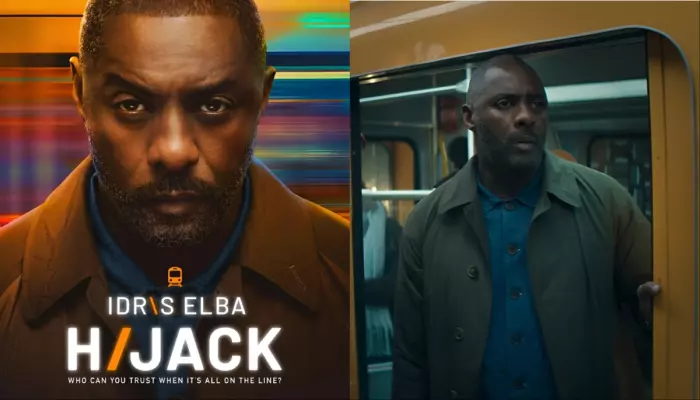
Season 2 of Hijack arrives at its final station with Episode 10, “Terminal”, and fittingly, it feels like a train pulling in after a long, exhausting journey that forgot why it left the station in the first place.
It began as an ambitious expansion of the high-altitude claustrophobia that defined Season 1, slowly unravelled into a scattered narrative stitched together by artificial tension, shaky antagonists, and plot threads that never quite justified their presence. By the time the finale closes its doors, it’s hard not to feel that both the passengers and the audience are relieved that the ordeal is over.
A Season Searching for Its Purpose
Unlike the first season, which thrived on tight storytelling and contained suspense, Season 2 often seemed uncertain of its identity. Was it a revenge thriller, a prison conspiracy drama, or a social commentary about trauma and consequence? It tried to be all three and struggled to be even one convincingly.
The finale amplifies the core issues that plagued the season. Instead of escalating action, we get extended conversations. Instead of sharp revelations, we’re handed ambiguous resolutions. Instead of an emotional payoff, we’re left to fill in the blanks ourselves.
At its bare minimum, viewers wanted closure. What they received was something closer to narrative fog.
The Train Reaches the Terminal But At What Cost?
“Terminal” delivers on its title in the most literal sense. The train, even with explosives strapped beneath it, reaches its final stop, but the emotional and thematic payoff never quite arrives. Throughout the season, the tension hinged on the looming threat of detonation. Yet when the end finally comes, it’s not a thunderous climax; it’s more of a muted collapse. An explosion occurs, yes, but it feels less like a shocking crescendo and more like a narrative device disguising an execution.
There’s no cathartic bang. Just a blur!
Peripheral Chaos Finally Converges
Season 2 often felt like it was juggling entirely separate shows; storylines outside the train and the control room consumed valuable screen time. A detective tirelessly tracing the bomb’s origins, neighbors entangled in side conspiracies, scattered players with unclear stakes — most of it rarely intersected in meaningful ways.
In the finale, these threads finally converge. But instead of rewarding viewers' patience, the convergence reveals how unnecessary many of them were.
The detective’s long pursuit of the bomb maker results in a hollow breakthrough. After all the legwork, all the interrogations, all the tension, the revelation amounts to little. Those scenes could have been used differently perhaps to explore the lives of the train passengers more intimately.
Imagine if we had seen more flashbacks, more human context. Some of the deaths might have hit harder. Instead, certain losses feel less like tragedy and more like last-minute reminders that a hijacking should probably have casualties.
The Stuart Twist: Shock Over Sense
The finale’s biggest swing is its revelation that Stuart, long positioned ambiguously within the chaos, is the true architect behind the hijacking.
It initially appeared to be a desperate jailbreak unfolds as a meticulously orchestrated revenge plot. On paper, it’s great. In practice, it collapses under scrutiny.
Stuart, a mid-level criminal locked in a maximum-security prison, allegedly manages to coordinate mercenaries, manipulate insiders within German law enforcement, blackmail operatives, and orchestrate a transnational murder plot, all while under constant surveillance.
It’s the kind of criminal empire-building that works in shows set inside prison ecosystems where influence flows freely. But here, every move should have been recorded, every conversation is monitored, and the logistics alone are dizzying.
How did he recruit so many players? What contingency plans existed if someone refused? How did he guarantee John and Sam would both end up on the train? The plan contains so many potential points of failure that its partial success feels more accidental than masterminded. The twist aims for jaw-dropping. Instead, it inspires raised eyebrows.
Villains Without Bite
Part of the problem lies in the antagonists themselves; they never felt formidable. Otto, introduced trembling in the season premiere, comes across as an amateur caught in over his head. His early moral hesitation quickly erases any sense of menace. By Episode 2, he’s practically searching for redemption.
Jess, meanwhile, seems visibly disturbed by the violence around her. There’s no cold precision. No terrifying conviction. Just discomfort. These are not the kind of calculated villains who convincingly execute elaborate revenge schemes from behind bars; they feel like reluctant participants, not hardened operatives.
When antagonists lack professional ruthlessness, the threat diminishes and with it, the suspense.
The Ghost of Flight KA29
To understand the chaos, we must rewind to the events of Season 1.
John Bailey-Brown’s earlier imprisonment led to the hijacking of a commercial plane - Flight KA29 - orchestrated to secure his release. But his motives extended beyond freedom. He manipulated the crisis to sabotage Kingdom Airlines’ stock, betting against it for financial gain. After escaping to Germany, he left others to face the consequences.
Stuart paid the price. His brother died, and he went to prison. According to the finale, Stuart may have arranged Kai’s death from behind bars. On the anniversary of that loss, he allegedly activated a revenge blueprint involving blackmail, insider corruption, and forced participation from Sam.
The objective was to get John and Sam onto a train, detonate it, and end the cycle with fire. It’s grand in ambition, almost Shakespearean in vengeance, but implausible in execution. When the mastermind is someone with limited reach and constant surveillance, the scale strains credibility.
A Season of Fabricated Stakes
Much of Season 2’s tension feels manufactured rather than earned. Conflicts arise because the script demands urgency, not because character motivations naturally collide.
Marsha and her neighbors, for example, ultimately play a role in the final stretch. Yet their extended buildup across eight episodes feels disproportionate to the payoff.
Over 90% of the off-train subplots could have been trimmed without sacrificing coherence. In fact, confinement might have strengthened the story.
Season 1 thrived on isolation- 30,000 feet in the air, cut off from outside interference. Season 2 disperses its energy across cities, prisons, neighborhoods, and investigation rooms. Without the sky-high isolation of an airplane cabin, the show loses its defining pressure cooker.
The Emotional Gaps
Perhaps the most disappointing absence in “Terminal” isn’t logic, as we don’t get meaningful reunions. No lingering embraces between survivors. No definitive answers about certain relationships that viewers quietly invested in, including the teachers whose bond suggested something deeper. Were they a couple, or were those glances intentional? The finale doesn’t clarify.
Instead of relief, we get narrative ambiguity. The season closes abruptly, almost literally blurred. It feels as though the story simply runs off track.
The Final Verdict
“Terminal” serves as a conclusive chapter, but not a satisfying one. It cements the feeling that this story didn’t need continuation.
The original premise, an ordinary person navigating extraordinary danger aboard a hijacked plane, was compelling. Expanding it into an ongoing franchise without reinventing the structure diluted its impact.
Perhaps the anthology route would have worked better with new protagonists, new flights, and fresh high-altitude crises. because without the aeroplane, without that suffocating isolation above the clouds , Hijack loses the very element that made it soar.
Season 2 wanted viewers to suspend disbelief. It just didn’t give them enough reason to, and so, as the train reaches its terminal, it’s relief, and the journey is finally over.
Read more: Hijack 2026